


Part 1 of 2
You can't vibe code a humanoid

OpenAI made writing software cheap. Now it's hiring people to build robots.
In May, Sam Altman posted that OpenAI Robotics was hiring hardware and manufacturing engineers. By September, its careers page listed 27 robotics roles, up from 11 in May.
That's the company that made code cheap, betting on the things code can't build.
You could see the same shift at MTF, a tech conference in London, this summer. You'd expect the crowd around the latest AI startup.
The queue was for the robots.
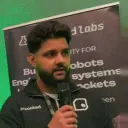
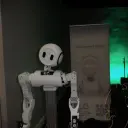
Hassan Shahzad and Joe Clinton brought Elo Lite, the wheeled humanoid they're building at Elo. People came over to look and stayed to ask how it worked.
Osman brought a drone with robotic arms from Invictus Robotics, and it had its own circle. People wanted to know how you get a flying machine to use its hands.
Haider Ali and Mohammad Yaameen Zafar brought ClearZone, a physical product for creating phone-free zones. The phone got us into this mess. ClearZone is a box that gets us out.
If that sounds like Brick, it's close, but it works the other way round. Brick is a block you tap your own phone on to lock yourself out of your apps. ClearZone's first product, FocusField, works on the room. Walk into the zone and your chosen rules apply to supported phones automatically, while calls, music and notes keep working. It's starting with schools, priced per classroom.
Raihaan Usman brought Bench, AI tooling that lets a small hardware team move like a big one.
Software got cheap. The bottleneck moved.
Writing the code used to be the hard part. Now the hard part is knowing what to build.
When one part of a job gets that cheap, the value moves to whatever is still hard. In tech right now, the hard part is making physical things work.
Take Elo Lite. AI can write its control code. With AI now plugged into Blender and CAD tools, it can even get you a decent first model of the parts. What it can't do is get every tolerance, load and joint exactly right. A humanoid has hundreds of points of failure. A motor overheats. A joint wears. A wheel slips on a polished floor. A battery dies halfway through the demo. You only find each one when the thing is built and switched on.
Same with ClearZone. AI can help design the box, but it can't tell you whether it survives a year in a busy classroom, or whether the zone stops where the classroom wall does. And no model is going to give a drone hands.
Even the everyday stuff is hard. Recently Dyson launched CameraJet, an electric toothbrush with a built-in camera that finds the gaps between your teeth and fires small bursts of mouth rinse into them. It took six years and 661 engineers.
A toothbrush.
Now picture a humanoid.
Software fails on a screen, and you fix it before lunch. Hardware fails in your hands, and the fix is a new part, a new order and a few weeks of waiting. In hardware, every mistake has a delivery date.
Bench shows where this goes: AI doing the software work, so a small team can spend its hours on the parts that break.
Most people avoid problems like that, which is why there's so much room in them. Robots, drones, energy, devices, manufacturing. I think a lot of the interesting companies of the next decade will be built on things that have to work outside a browser.
The race has already started
OpenAI isn't the one in front. China is. Chinese makers shipped more than 18,500 humanoid robots in the first half of 2026, over 97% of the roughly 19,100 delivered worldwide. Beijing has made embodied AI a priority for the next five years, telling local governments to subsidise startups with land and office space and ordering banks to lend on favourable terms.
Britain should be building here too. We've done it before. Some of the first autonomous robots were built in Bristol in the 1940s. Shadow Robot has been building robot hands in London since the 1980s. Google DeepMind, headquartered in London, is building robotics models now.
The talent is still here
The question is whether it stays.
So why aren't more people building these things? Part of the answer is that you can't learn hardware from a tutorial. You learn it from someone who has already fried a batch of boards, standing next to you, telling you which part not to order.
So hardware needs rooms. And right now, most of the people who could build these things never get into one.
Part 2: why the talent never gets near the work. The gap is proximity
Sources: OpenAI hiring, eWeek · OpenAI robotics roles · China humanoid shipments, TechNode · Beijing policy, CNBC · Dyson CameraJet, Irish Examiner · Grey Walter's Bristol robots · Shadow Robot · Gemini Robotics, Google DeepMind · ClearZone · Brick